AI Literacy Course Pack
Can Your Students Spot What AI Got Wrong?
AI-generated passages with real hallucinations hidden inside. Students use Hypothesis to find fabricated citations, check facts, and build verification skills — together.
HOW IT WORKS
Four steps. Works anywhere.
Upload
Choose a passage for your discipline and upload the PDF to your LMS with Hypothesis.
Assign
Students annotate the passage — checking claims, verifying citations, flagging errors.
Collaborate
Use LMS groups so small teams work independently. Annotations are visible within each group.
Debrief
Reveal the answer key. Discuss what was caught, what was missed, and why it matters.
HOW IT WORKS
Four steps. Works anywhere.
WHAT STUDENTS SEE
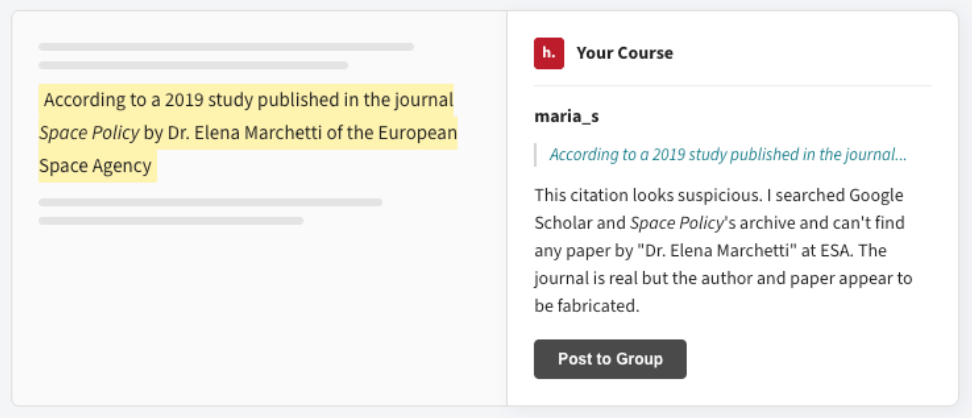
Verification happens in the margins.
Students highlight a suspicious claim, write an annotation, and their classmates see it instantly. The conversation builds in context — right next to the text itself.
CHOOSE A PASSAGE
Four passages. Four disciplines. Pick one.
Each passage is a standalone activity designed for a specific discipline. Every one contains 5–7 embedded errors at three difficulty tiers.
Familiar material with unfamiliar errors. Tests whether students verify what they think they already know.
Tier 1 — Obvious
Completely fabricated citations. Nonexistent authors, invented journals.
Tier 2 — Subtle
Tier 3 — Tricky
Everything you need. Nothing you don’t.



Hypothesis is the market-leading social annotation platform for higher education, used at more than 300 colleges and universities. It integrates directly into your LMS — Canvas, Blackboard, Moodle, or D2L — so students can highlight text, ask questions, and have conversations in the margins of any PDF, web page, or ebook without leaving your course. Hypothesis is built around three outcomes that matter right now: student engagement and collaboration (turning solitary reading into active, visible, peer-to-peer learning), AI-resistant workflows and literacy (assignments that require genuine critical thinking and can’t be shortcut by generative AI), and career preparation (building the close-reading, source-evaluation, and collaborative skills employers actually look for). Learn more at hypothes.is.
You need Hypothesis enabled in your LMS. If your institution already has Hypothesis, you’re ready — just upload a student PDF as a Hypothesis assignment. If you’re not sure whether your school has access, contact your LMS administrator or visit hypothes.is/get-started.
AI hallucinations are confident-sounding claims that an AI system generates that are factually wrong — fabricated citations, invented statistics, nonexistent authors, or misattributed quotes. They look convincing because the language is fluent and the format is correct, even when the content is not. This course pack uses real examples of hallucination types to teach students how to recognize and verify them.
Social annotation is a pedagogical practice where students add notes in the margins of digital texts — questions, insights, replies to classmates, links to related sources — creating a conversation about what they’re reading. It makes reading active, visible, and social: active because annotation requires close engagement with the text, visible because students can see each other’s thinking in real time, and social because the conversation builds collaboratively, right next to the words being discussed. Research shows social annotation leads to measurable gains in comprehension, participation, and critical thinking across disciplines.
Generative AI can produce a discussion board post in seconds. It can’t replicate the process of reading a passage, identifying a suspicious claim, searching for the original source, and explaining what you found to classmates — all anchored to a specific line of text in a shared document. Social annotation creates a visible trail of genuine student thinking that’s difficult to replicate with AI shortcuts. This course pack takes that a step further by making AI itself the subject: students learn to evaluate AI-generated content by doing the work AI can’t do for them.
Yes. The course pack is licensed CC BY 4.0, which means you can use, share, and adapt it with attribution. We’ll ask for your name, email, and institution when you download so we can follow up once to ask how it went — that’s it.
Pick the one closest to your discipline. The Space Race works for any course — it’s the most broadly accessible. The American Revolution fits humanities and general education. Governing the Machine is designed for social science, law, and policy courses. The Python Code Review is for computer science and data science students. You only need one.
Absolutely. The activity works in any modality — face-to-face, online, hybrid, synchronous, or asynchronous. Students annotate on their own time, and the conversation builds as classmates add to it. The debrief can happen in class or via a follow-up discussion.
Use your LMS group sets with Hypothesis’ group assignment feature. Split students into small teams of 4–6, and each group gets its own annotation layer. They only see their group’s work, which keeps the investigation genuine. The instructor guide includes detailed setup instructions.
FAQ
Common questions
What is Hypothesis?
Do I need a Hypothesis account to use this course pack?
What are AI hallucinations?
What is social annotation?
How does this help with AI-resistant assignments?
Is this really free?
Which passage should I use?
Can I use this in an online or asynchronous course?
How do I keep 25 students from all finding the same errors?