Transform how your team collaborates over content.
Flexible annotation and commenting tools that let you control discussions, customize your interface, and create secure collaborative conversations across your content.
Capabilities
Everything your organization needs to collaborate smarter.
Whether you want granular discussions or lightweight feedback — Hypothesis gives you the flexibility to choose the model that fits your team.

Annotations & Comments
Use annotations for precise, line-level discussion — ideal for product docs, research reviews, or editorial workflows. Or enable page-level comments for fast, general feedback.

Your Brand, Your Interface
Embed Hypothesis with a fully branded interface that reflects your organization’s identity. Guide users to the groups and conversations that matter most.

Open & Restricted Groups
Decide who can contribute — from broad public participation to curated expert commentary. All annotations remain readable to anyone, while posting rights stay controlled.

Publisher Groups
Host conversations directly on your content, visible to everyone or limited to selected contributors. SOC-2 grade security keeps your data protected at every level.
Moderation
Total control over your discussions.
Choose the level of oversight that fits your workflow. No matter your configuration, you maintain complete control over the conversations on your site.
Default
Post-Moderation
Notes appear immediately. Moderators can hide content that violates guidelines. Users can flag notes for review at any time.
Optional
Pre-Moderation Queue
New notes enter a private queue. Moderators approve or decline before anything appears publicly — ideal for editorial, brand, or compliance standards.
Optional
Constrained Group Selection
Limit available groups within the embedded client. Ensure users post exactly where you need them to — essential for publishers and research sites.
Feature comparison
Publisher Groups vs. the free version.
| Feature | Publisher Groups | Free Version |
|---|---|---|
| Annotate the web | ✓ | ✓ |
| Public annotations | ✓ | ✓ |
| Private annotations | ✓ | ✓ |
| No storage limits | ✓ | ✓ |
| Control who can post | ✓ | — |
| Company-moderated annotations | ✓ | — |
| Branded interface | ✓ | — |
| Group management control | ✓ | — |
| SOC-2 grade security | ✓ | — |
Real-world impact
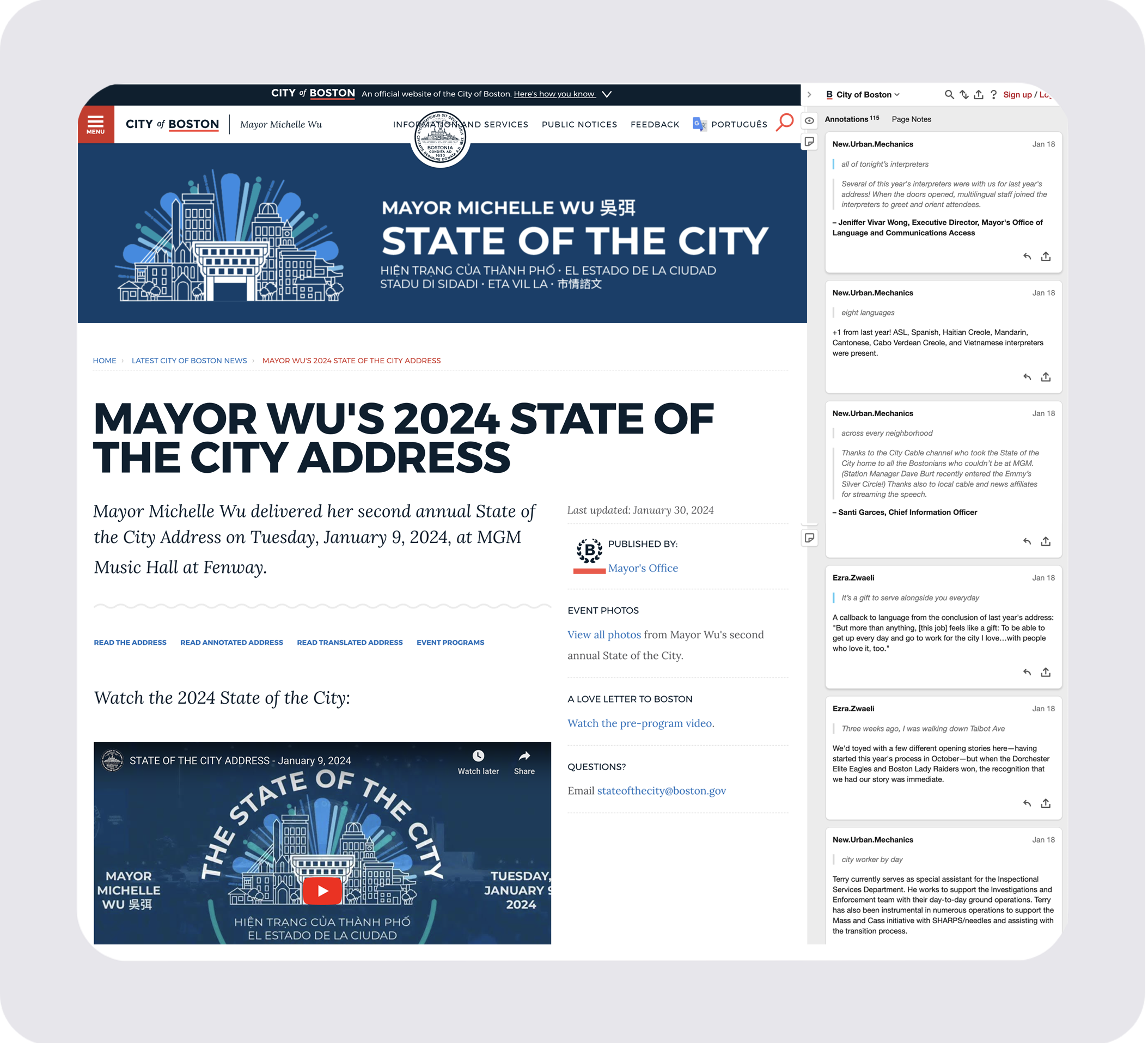
How the City of Boston brought their State of the City address to life.
The City of Boston used Publisher Groups to enrich their State of the City address with context, resources, and expert insights — all delivered through live annotations over the official transcript.
FAQ
Common questions about Hypothesis for Business.
Hypothesis Publisher Groups is a business-tier product that lets organizations embed Hypothesis directly on their website with a branded interface. It gives site owners full control over who can post annotations, how discussions are moderated, and which groups users can access — while keeping all annotations publicly readable without requiring an account.
Annotations are anchored to a specific passage or image in a document, making them ideal for precise, line-level feedback such as scholarly review, editorial workflows, or product documentation. Comments (also called page notes) sit in the sidebar without requiring users to select text, offering a familiar and low-friction way to leave general feedback on a page. Organizations can enable one or both modes depending on the type of discussion they want to encourage.
Open Groups allow anyone to post annotations within the group, making them ideal for public engagement, open peer commentary, or community-driven analysis — while site owners retain full moderation control. Restricted Groups limit posting to selected contributors only, but their annotations remain visible to all readers. This makes Restricted Groups ideal for curated expert commentary, staff-only insights, or compliance-sensitive environments.
Publisher Groups offer two moderation modes. Post-moderation (the default) lets notes appear immediately while giving moderators the ability to hide content that violates guidelines — users can also flag notes for review. Pre-moderation is an optional setting that sends every new note into a private approval queue before it appears publicly, ensuring every visible contribution meets editorial, brand, or compliance standards.
Yes. Anyone can read annotations in public or Publisher Groups without creating a Hypothesis account. This makes it easy to surface expert commentary, editorial notes, or curated insights to the broadest possible audience while keeping posting rights tightly controlled.
Yes. Hypothesis Publisher Groups includes SOC-2 grade security, Restricted Groups that control who can contribute, pre-moderation queues for compliance-sensitive content, and viewer-only access for non-users. These features make it suitable for corporate, research, and government use cases where data governance and content control are critical.
The free version of Hypothesis lets anyone annotate the web with public or private annotations and no storage limits. Publisher Groups add enterprise-level features on top of this foundation: control over who can post, company-moderated annotations, a branded embedded interface, group management control, and SOC-2 grade security — none of which are available in the free tier.
Yes. Publisher Groups include a Constrained Group Selection option that lets site owners limit which groups are available inside the embedded Hypothesis client. This ensures users post exactly where you want them to — particularly useful for publishers, brands, and research platforms where consistency and clarity of conversation matter most.
Get started today
Ready to bring richer conversations to your site?
Transform how your organization collaborates, communicates, and reviews content online. Flexible discussion modes, customizable groups, complete control over moderation.