OPEN EDUCATIONAL RESOURCES
OER, Open Access or Just Free Online — Hypothesis Makes Any of It Work
If you assign PDFs, web articles, YouTube videos, or open textbooks, Hypothesis turns any of them into engaged, measurable learning — whether it’s formally licensed OER, open access, or just free online.
UNDERSTANDING OER
What is OER?
Open educational resources (OER) are teaching, learning, and research materials released under an open license — usually Creative Commons or public domain — that lets faculty freely use, adapt, remix, and redistribute them. OpenStax textbooks, Pressbooks-hosted titles, and LibreTexts are OER.
OER sits inside a broader category of free and open content that faculty assign every day: open access journal articles, public-domain texts, government reports, news articles, YouTube videos, and anything else students can reach without a paywall. The licensing differs, but the classroom problem is the same — assigning free content doesn’t mean students engage with it.
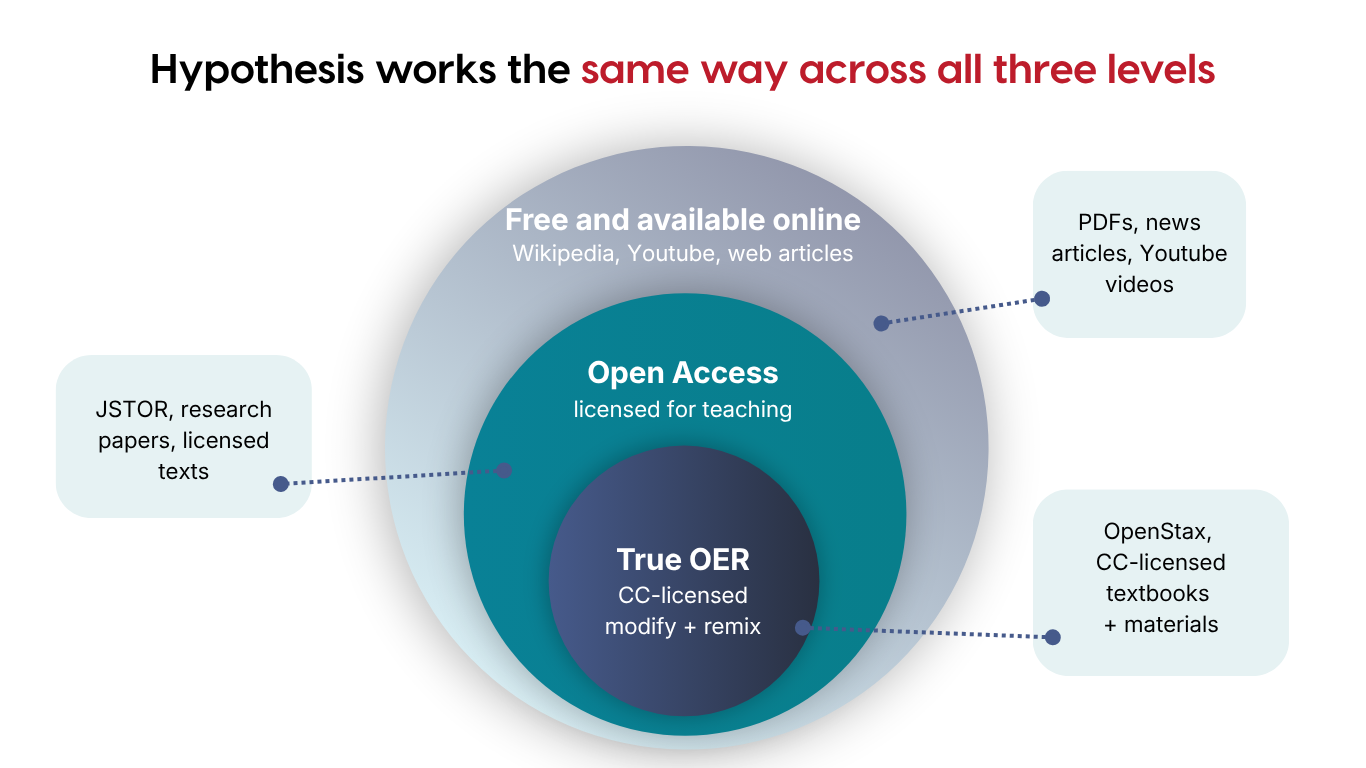
Free and available online
Wikipedia, YouTube, news articles. Anyone can access them. Hypothesis works with all of these.
Open Access
Licensed for educational use — JSTOR, research papers, public-domain texts. Hypothesis works with these too.
True OER
Creative Commons licensed (CC BY 4.0) — OpenStax, Pressbooks, LibreTexts. Modify, remix, redistribute. Hypothesis works with all of these.
Hypothesis works the same way across all three levels. You don’t need to change what you assign. You just add Hypothesis on top.
CLARIFYING THE DIFFERENCE
What’s the difference between OER and open access?
OER and open access (OA) are often used interchangeably, but they’re not the same thing:
- OER — released under an open license (Creative Commons, public domain) that permits use, adaptation, remixing, and redistribution. Examples: OpenStax, Pressbooks, LibreTexts, MERLOT.
- Open access — free to read but still copyrighted. You can assign and link to it, but you can’t legally modify or redistribute it. Examples: most open-access journal articles, news articles, public web content, most YouTube videos.
Both categories solve the cost problem for students. Neither solves the engagement problem on its own. Hypothesis works with both — and with publisher content too.
CONTENT COMPATIBILITY
What free and open content can I use Hypothesis with?
Anything with a URL. That includes:
OER — OpenStax, Pressbooks, LibreTexts, MERLOT, and any openly-licensed textbook
Open access content — journal articles, public-domain texts, government reports, primary sources
PDFs — uploaded to your LMS or hosted online
Web pages and articles — news, blogs, Wikipedia, anything publicly accessible
YouTube and video — lectures, documentaries, news clips, primary footage
Publisher content — Hypothesis also works with paid textbooks and licensed library content
Most faculty assigning “free readings” don’t draw a line between OER and open access — they’re solving the same problem, which is giving students access to material without charging them. Hypothesis adds the engagement layer to all of it.
THE PROBLEM WE SOLVE
Why doesn’t free reading drive engagement on its own?
Publisher content came with quizzes, analytics, and discussion prompts that made students accountable. Open and free content doesn’t. When faculty switch from a $120 textbook to a PDF or a YouTube video, the cost problem is solved but the engagement problem gets worse — there’s no built-in way to know whether students actually opened it.
Hypothesis gives that visibility back. Every annotation is timestamped and tied to a specific passage — so you can see who read, what they highlighted, and how they responded to each other. Students aren’t just reading passively — they’re thinking out loud in the margins, building understanding together.
HOW IT WORKS
How does Hypothesis fix this?
Hypothesis is a social annotation layer that works on any URL: PDF, web page, open textbook, or video. Students annotate directly in the source — asking questions, responding to peers, reacting to instructor-seeded prompts. Faculty see who participated, how deeply, and grade it through the LMS gradebook.
The same workflow works whether the assigned reading is a chapter from OpenStax, a PDF on your course site, a YouTube documentary, or an article from The Atlantic. And the quality of the assignment matters as much as the tool.
GETTING STARTED
How do I assign a PDF, web article, or video with Hypothesis?
Inside Canvas, Blackboard, Brightspace, D2L, Moodle, or Sakai:
- Create a Hypothesis assignment
- Paste the URL or link to the PDF
- Optionally seed it with instructor annotations and prompts
- Students annotate
No new tool for students to learn, no separate account, no leaving the LMS.
VISIBILITY AND ANALYTICS
How do I track engagement on free readings?
Hypothesis gives instructors per-student visibility into annotation count, depth, timing, and peer interaction — for any source. This is the analytics layer publisher platforms provided for paid content, applied to whatever you’re actually assigning. Grades appear in the LMS gradebook.
PLATFORM COMPATIBILITY
Does Hypothesis work with OpenStax, Pressbooks, and LibreTexts?
Yes. Hypothesis works with OpenStax, Pressbooks, LibreTexts, MERLOT, and any open-textbook platform that publishes to the web. Pressbooks has a particularly deep integration; the others work through standard LMS assignments.
FOR TRUE OER ADOPTERS
For faculty remixing OER: annotation as part of the process
If you’re working with content you actively modify and redistribute, Hypothesis supports the whole cycle.
Students annotate the source text collaboratively — sharing research, flagging questions, and building a layer of collective understanding directly on the document. That annotation layer becomes the foundation for remixing: what needed more explanation? What would the next cohort benefit from seeing?
Your annotation data is always exportable. You own it. Use it to improve the text, share it with the next semester’s cohort, or publish it alongside the resource.
Not sure how to structure the activity? Here’s how to scaffold a textbook annotation assignment so students know exactly what to do.
AI AND CRITICAL THINKING
How does this hold up against AI?
“Social annotation is the human-centered work of questioning, connecting, and responding in the margin — the thing AI can’t shortcut.”AI can summarize any free reading — a PDF, an open textbook, a YouTube transcript — in seconds. That makes assigning it optional unless students do something with the source that AI can’t shortcut. It keeps free readings meaningful in a world where AI can otherwise do them for the student.
See how faculty are already making it work with a real case study. We’ve written more on how to think about this shift in your classroom.
PROVEN AT SCALE
Where has this worked at scale?
The University of Wisconsin-Milwaukee paired Hypothesis with their OER initiative across 49 courses and 1,067 students, generating over 27,000 annotations in a single semester.
PRICING
How much does Hypothesis cost?
Hypothesis is licensed at the institution level by full-time-equivalent students — not per course, per assignment, or per resource. Faculty using free and open content pay nothing extra to assign it through Hypothesis. For institutions already saving on textbook costs by shifting to OER, Hypothesis is typically a small fraction of the savings and the line item that determines whether students actually engage.
GET STARTED
How do I get started?
If you’re already assigning PDFs, links, videos, or open textbooks, Hypothesis is the layer that makes them work.
FAQ
Frequently asked questions
Is a PDF I assign to my class considered OER?
Only if it’s released under an open license like Creative Commons. Most PDFs faculty assign are open access (free to read, still copyrighted) rather than OER, but Hypothesis works with both.
Is a YouTube video OER?
Only if it’s published under an open license. Most YouTube videos are free to watch but copyrighted — which makes them open access rather than OER. Hypothesis works with both.
Do I need to switch textbooks to use Hypothesis?
No. Hypothesis works with whatever you already assign — publisher textbooks, OER, PDFs, articles, video.
Is Hypothesis accessible (WCAG / ADA Title II)?
Yes. Current VPAT from OCAD University’s Inclusive Design Research Centre.
Can students keep their annotations after the course ends?
Yes. Student annotations persist in the student’s Hypothesis account.
Does Hypothesis work with free PDFs and web articles, not just official OER?
Yes — Hypothesis works with any publicly accessible web content, PDFs, and open textbooks. You don’t need content with a Creative Commons license. If your students can access it, you can annotate it.
How does Hypothesis support faculty who are remixing OER?
When students annotate an OER text collaboratively, they build a layer of shared understanding directly on the document — flagging what needs more explanation, surfacing research, and adding context. That annotation layer can inform how you revise the text for next semester. Your annotation data is always exportable.
Which LMS platforms does Hypothesis integrate with?
Hypothesis integrates natively with Canvas, Blackboard, Brightspace, Moodle, D2L, and Sakai. Students access annotation directly inside your course — no separate account or new tool to learn.
Only if it’s released under an open license like Creative Commons. Most PDFs faculty assign are open access (free to read, still copyrighted) rather than OER, but Hypothesis works with both.
Only if it’s published under an open license. Most YouTube videos are free to watch but copyrighted — which makes them open access rather than OER. Hypothesis works with both.
No. Hypothesis works with whatever you already assign — publisher textbooks, OER, PDFs, articles, video.
Yes. Current VPAT from OCAD University’s Inclusive Design Research Centre.
Yes. Student annotations persist in the student’s Hypothesis account.
Yes — Hypothesis works with any publicly accessible web content, PDFs, and open textbooks. You don’t need content with a Creative Commons license. If your students can access it, you can annotate it.
When students annotate an OER text collaboratively, they build a layer of shared understanding directly on the document — flagging what needs more explanation, surfacing research, and adding context. That annotation layer can inform how you revise the text for next semester. Your annotation data is always exportable.
Hypothesis integrates natively with Canvas, Blackboard, Brightspace, Moodle, D2L, and Sakai. Students access annotation directly inside your course — no separate account or new tool to learn.