Transform course reading into collaborative learning across California Community Colleges
California Community Colleges can access Hypothesis through the Systemwide Technology Access Collaborative (STAC), with ordering handled by the Foundation for California Community Colleges (FCCC) CollegeBuys program. Get pre-negotiated institutional pricing, seamless Canvas integration, and proven reading engagement that supports Zero Textbook Cost (ZTC) and OER initiatives.
Simpler procurement. Proven engagement. Systemwide equity.
Hypothesis is a participating vendor in the Systemwide Technology Access Collaborative (STAC), a systemwide collaboration between the California Community Colleges Chancellor’s Office, FCCC’s CollegeBuys program, and the California Virtual Campus (CVC). Through STAC, all 116 California Community Colleges can access Hypothesis at systemwide institutional pricing.
Whether you represent a large multi-college district or a single campus, STAC removes local RFP hurdles, ensures compliance with the California Education Code and Public Contract Code, and pools purchasing power so every college gets the same competitive price.
What Hypothesis does for your classrooms and your campus
Active, social, and authentic learning in Canvas
-
Sustained reading engagement
Turn static course PDFs, web content, and library readings into social discussions. Students annotate together in the margins, answer questions, and build knowledge as a group.
-
Authentic human engagement
AI tools make standard summaries and static prompts easy to bypass. Hypothesis captures line-by-line student thinking and peer dialogue in the text itself, so the focus moves from final output to visible learning.
-
Supercharge OER & ZTC materials
Free access alone doesn’t guarantee engagement. Add an interactive layer over OpenStax, Pressbooks, LibreTexts, JSTOR, and VitalSource, with real-time visibility into student reading.
-
Preparation for the digital workforce
Build the digital literacy, collaborative argument, and close-reading skills students need in remote and hybrid careers.
-
Canvas & SpeedGrader workflows
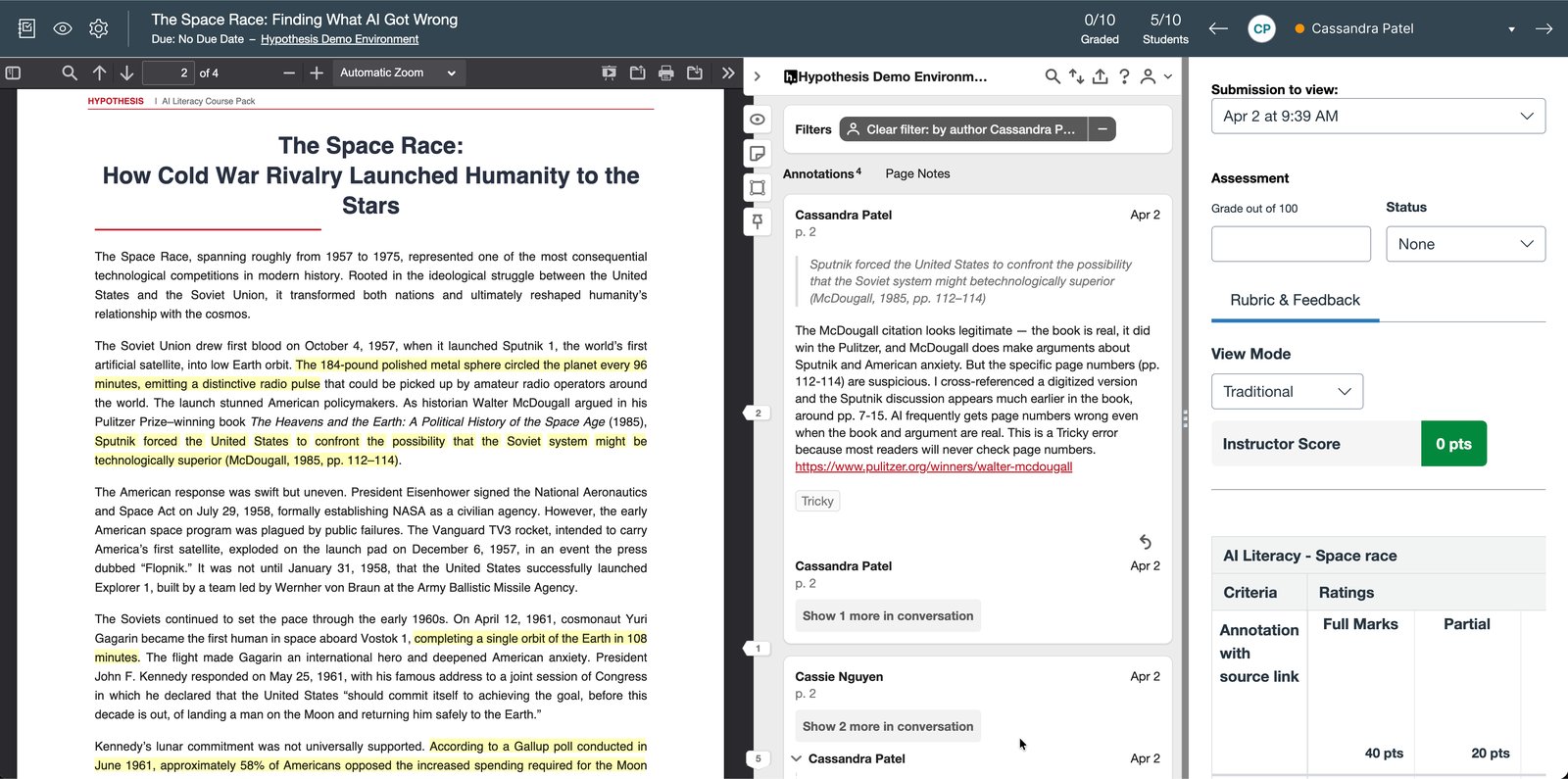
Assign annotation tasks directly in Canvas and grade each student’s contributions side by side in SpeedGrader in seconds.
Maximize EdTech ROI and stay compliant
-
Aggregated savings & pricing parity
Use systemwide volume discounts. Small and large colleges get the same competitive pricing through CollegeBuys.
-
Turnkey compliance, reduced risk
Skip complex RFP cycles. Purchasing through STAC complies with the California Education Code and Public Contract Code, and Hypothesis is FERPA compliant and meets WCAG 2.1 AA, with a published VPAT.
-
Retention & equity
Social annotation creates low-stakes, peer-supported reading spaces. Cerritos College saw a 24% increase in English course retention.
-
LMS & SSO consolidation
Single Sign-On and deep Canvas integration simplify your tech stack and reduce IT overhead.
Real impact at a California Community College
English Professor Jennifer Jozwiak introduced Hypothesis across face-to-face and online writing courses to close reading comprehension gaps for a diverse student population.
Hypothesis has met our diverse student body’s needs, promoting active, collaborative learning, and enhancing comprehension and critical thinking. It’s helped break down barriers for students and allow them to engage more with course materials.
Jennifer Jozwiak · Faculty Member, Allan Hancock College
Make open textbooks interactive
California Community Colleges lead the nation in Zero Textbook Cost and OER degree pathways. Hypothesis is the interaction layer that turns free content into active reading.
Annotations per student
Nearly 2× the engagement on open materials
Students annotate open textbooks almost twice as much as traditional course materials, giving faculty a clear view of who is reading and where they get stuck.
Works with the open texts you already use
Out-of-the-box support for the major OER and library platforms. Pressbooks has Hypothesis built in as a setting.
No per-resource fees
One flat interaction layer across every course material format in Canvas.
Build RSI into every online course, right in the reading
Federal rules require distance education courses to include regular and substantive interaction between instructors and students. Discussion boards often fall flat, especially for working students. Hypothesis puts that interaction in the course readings, where it happens every week and leaves a record in Canvas.
Online courses where students stopped waiting for the instructor
Adjunct instructor Jennifer Young replaced discussion boards with weekly Hypothesis annotation in her online Employment Law, Business Law, and Investing courses, all built on OER. Each week students annotate the reading, pose questions, respond to peers, and add outside resources.
“The students are engaged from the very beginning. They’re helping each other, they’re learning, and they’re not just waiting for the instructor to respond.”
Make interaction part of the weekly reading
-
A routine students can follow
Use the UAF model: each week, annotate the reading, ask a question, reply to classmates, and bring in an outside source. It's regular by design.
-
Feedback where students are reading
Answer questions and add guidance in the margin, so your presence in an online course is visible on the page instead of buried in a forum.
-
Peers answer each other, any hour
Asynchronous students get quick answers from classmates, which builds a learning community across schedules and time zones.
-
See authentic student thinking
A semester of annotations shows how each student reads and reasons, which makes AI-generated submissions easier to spot.
Document RSI across online sections
-
Evidence for compliance reviews
Every instructor reply and peer exchange is timestamped in the course. That gives you a concrete record of interaction for distance education reviews and accreditation.
-
Protect distance education status
Online courses without RSI can be classified as correspondence courses, which affects federal financial aid. Hypothesis gives faculty a repeatable way to meet the standard.
-
Better online outcomes
At UAF, failure rates dropped and grades rose once annotation replaced discussion boards, with fewer students withdrawing.
-
One tool, every online section
The same STAC license covers face-to-face, hybrid, and online courses in Canvas, so there's no separate RSI tool to buy or support.
Test in spring, lock in STAC savings by June
The annual STAC purchasing window closes in June. Here’s the three-step runway for your campus.
- 1
Spring semester
Launch a spring pilot
Test Hypothesis in selected Canvas courses at no cost. Gather feedback from faculty and students.
$0 · No commitment - 2
Before June
Review your STAC quote
CollegeBuys prepares a custom quote using pre-negotiated STAC systemwide pricing.
Prepared by CollegeBuys - 3
Deadline · June
Submit your order
Finalize your institutional order before the June STAC deadline to lock in pricing for the next academic year.
Pricing locked for the next academic year
Start your pilot now so your quote is ready before the deadline.
Hypothesis & STAC: frequently asked questions
Quick answers for California Community College faculty, deans, IT, and procurement teams.
What is Hypothesis?
Hypothesis is a social annotation platform for higher education. Students highlight and comment on course readings together, directly in the margins of PDFs, web pages, library readings, and open textbooks, and instructors assign and grade that work inside Canvas.
Is Hypothesis available through STAC for California Community Colleges?
Yes. Hypothesis is a participating vendor in the Systemwide Technology Access Collaborative (STAC), so California Community Colleges can access it at pre-negotiated institutional pricing through the Foundation for California Community Colleges (FCCC) CollegeBuys program.
What is STAC (Systemwide Technology Access Collaborative)?
STAC is a systemwide collaboration between the California Community Colleges Chancellor’s Office, the Foundation for California Community Colleges (FCCC) CollegeBuys program, and the California Virtual Campus (CVC). It gives all 116 California Community Colleges access to technology from participating vendors, such as Hypothesis, at systemwide institutional pricing.
Which California Community Colleges can buy Hypothesis through STAC?
All 116 California Community Colleges can buy Hypothesis through STAC, from large multi-college districts to single campuses.
Do California Community Colleges need an RFP to buy Hypothesis?
No. Hypothesis is a participating vendor in STAC, so California Community Colleges can order it through FCCC CollegeBuys without running a local RFP. Purchasing through STAC complies with the California Education Code and Public Contract Code.
Do small colleges pay the same price for Hypothesis as large districts?
Yes. STAC pools purchasing power across the California Community Colleges system, so small and large colleges get the same competitive pricing for Hypothesis through CollegeBuys.
Can a California Community College pilot Hypothesis for free?
Yes. California Community Colleges can run a free spring pilot of Hypothesis in selected Canvas courses, with no commitment, and gather feedback from faculty and students before ordering through STAC.
How does a college get a STAC quote for Hypothesis, and when is the deadline?
CollegeBuys prepares a custom quote for Hypothesis using pre-negotiated STAC pricing. Colleges must submit their order before the annual STAC deadline in June to lock in pricing for the next academic year.
Does Hypothesis integrate with Canvas?
Yes. Hypothesis integrates with Canvas: instructors assign annotation activities directly in Canvas courses and grade each student’s contributions in SpeedGrader. Hypothesis also supports Single Sign-On (SSO).
How does Hypothesis support OER and Zero Textbook Cost (ZTC) courses?
Hypothesis adds an interactive annotation layer to open textbooks and ZTC materials, including OpenStax, Pressbooks (where Hypothesis is a built-in setting), LibreTexts, JSTOR, VitalSource, and any web page, with no per-resource fees. In partner data from the University of Wisconsin–Milwaukee, students averaged 31 annotations each in OER courses versus 16 in non-OER courses.
Can Hypothesis help online courses meet Regular and Substantive Interaction (RSI) requirements?
Yes. Hypothesis supports Regular and Substantive Interaction (RSI) in online and distance education courses by putting instructor feedback, student questions, and class discussion directly in the course readings, with weekly annotation assignments in Canvas and timestamped records of every interaction. At the University of Alaska Fairbanks, an instructor who replaced discussion boards with weekly Hypothesis annotation reported a 1,400–2,100% increase in RSI across her courses. Read the University of Alaska Fairbanks case study.
What results have California Community Colleges seen with Hypothesis?
At Allan Hancock College, 95% of surveyed students found Hypothesis valuable for their coursework, and 67% of ENGL 100 students reported better reading comprehension and critical thinking. Cerritos College saw a 24% increase in English course retention.
Is Hypothesis FERPA compliant and accessible?
Yes. Hypothesis is FERPA compliant and meets WCAG 2.1 AA accessibility standards, and a VPAT is available.
Bring social annotation to your college this year
Faculty can see Hypothesis in their own Canvas course. Administrators can start the STAC paperwork now so nothing slows the June order.
Request a STAC Quote & Application
For deans, IT, and procurement. Fill out the form and our team will follow up.
Available to California Community Colleges through STAC and CollegeBuys · FERPA · WCAG 2.1 AA · VPAT available