Classroom Tip: Image Annotation Jams to Build Critical Thinking Skills with Visual Analysis
A common warm-up activity in humanities courses is visual analysis. In this exercise, instructors share an image related to the day’s topic or theme and invite students to examine it as a “text.” Students are often prompted to observe the formal elements of the text–its composition, color, shapes–before moving into analysis, where they pose questions, offer interpretations, and stake arguments about the text. By the end of the activity, a messy chalkboard or smudged dry-erase board brims with student ideas, serving as a vivid visual reminder of all the collaborative thinking that took place.
If you’ve ever facilitated this activity in your own classroom, you may have noticed students—or even yourself—taking pictures to document the record of the discussion. Perhaps these pictures have come in handy, but more likely, they’ve been forgotten in the roll of your iPhone photos, never to be seen again.
This is where Hypothesis image annotation comes in, providing a way to capture and preserve essential classroom discussions. You can use it in scaffolded activities, where you guide the stages of visual analysis, as students make formal observations, pose questions, and finally offer interpretations and analysis. Alternatively, you can run an annotation “jam,” where all students annotate simultaneously for a brief, focused period.
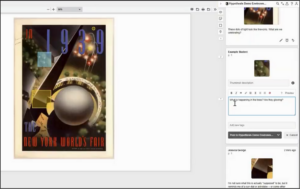
Example image annotation of a poster designed for the 1939 New York World’s Fair (Library of Congress).
A benefit of using Hypothesis for this work is that it lets instructors optionally track participation through the Hypothesis LMS app gradebook integration while also providing students with a lasting record of the discussion. Students can refer back to these annotations during lecture or outside of class to recall and build on observations first shared in the annotation jam. For more on annotation warm-up activities, check out our Tech Tip.
Want to see how Hypothesis can bring collaborative annotation to your classroom?
Fill out the form to request a quick walkthrough or explore case studies from schools using image and text annotation to boost student engagement.